
How to Brand a Manufactured Product: 7 Industrial Labeling & Emblem Methods Compared
Anyone who has brought a physical product from CAD to pilot production knows the pattern: six months go into perfecting the injection-molded housing, sheet-metal weldment, or extruded aluminum chassis, and the branding spec gets decided two weeks before the first shipment leaves the factory.
When the branding method is chosen at the last minute, it usually shows in the field six months later. A flat vinyl decal starts curling at the corners after three washdowns. A silkscreened logo rubs off the first time a technician wipes an enclosure with isopropyl alcohol. Or a heavy rigid ABS badge gets taped onto a tightly curved housing and pops loose on day four because internal spring-back tension overcame the adhesive.
No single badge or printing process works on every substrate. An ultra-thin 0.10 mm electroformed nickel transfer solves problems on a brushed aluminum coffee machine or audio preamp that a 1.8 mm polyurethane dome label cannot—and neither of them will replace a riveted 316 stainless steel serial plate on a 480V quarry motor or a velvet polycarbonate graphic overlay over a membrane keypad.
This reference breaks down the seven core physical product branding methods used in commercial manufacturing today, complete with real macro photography, tooling economics, adhesive chemistry, and where each technology fails if misapplied.
The 7 OEM Product Branding Methods Covered in This Guide
- 3D Polyurethane Dome Labels (Self-Healing Resin Lens)
- Electroformed Nickel & Metal Transfer Stickers (0.08–0.15 mm)
- Embossed Metallic Chrome Badges & Molded ABS Emblems
- Sub-Surface Printed Polycarbonate (Lexan) Graphic Overlays
- Anodized Aluminum & Laser-Etched Steel Serial Nameplates
- UV DTF Crystal Transfers & Soft PVC / Silicone Badges
- Direct Silkscreen / Pad Printing & Tamper-Evident Security Seals
- Master Engineering Comparison Table & Substrate Matrix
Master Engineering Comparison: All 7 Product Branding Technologies
Before looking at close-up examples, use this table to filter by your production volume, tooling budget, profile thickness, and operating environment:
| Branding Method | Profile Height | Upfront Tooling | Practical MOQ | Outdoor UV / Chemical Life | Best Primary Application |
|---|---|---|---|---|---|
| 1. 3D Polyurethane Dome Labels | 1.5 mm – 2.0 mm | $0 (Digital kiss-cut) | 50 – 100 pcs | 5–10+ yrs (Non-yellowing PU) | Full-color gradients, recessed enclosure bezels, HVAC, marine & electronics |
| 2. Electroformed Nickel Transfers | 0.08 mm – 0.15 mm | $80 – $250 (Photomask mandrel) | 250 – 500 pcs | 3–7 yrs (Indoor / covered outdoor) | Ultra-fine cut-out metallic letters without background film; audio, laptops, espresso gear |
| 3A. Flexible Embossed Chrome Badges | 0.4 mm – 0.8 mm | $300 – $900 (Matched embossing die) | 250 – 500 pcs | 5–8 yrs (Automotive UV topcoat) | 3D chrome + color accents on curved appliances, RVs, machinery & sporting goods |
| 3B. Injection-Molded ABS Chrome Emblems | 2.0 mm – 4.5 mm | $2,000 – $6,500 (Steel cavity mold) | 1,000 – 5,000 pcs | 7–10+ yrs (Trivalent chrome plate) | Automotive tailgates, boat hulls, heavy trucks, large commercial refrigerators |
| 4. Polycarbonate (Lexan) Graphic Overlays | 0.175 mm – 0.50 mm | $0 – $350 (Laser or steel-rule die) | 50 – 250 pcs | 5–10 yrs (Sub-surface printed ink) | Control panels, membrane switches, LED display windows, medical & lab instruments |
| 5. Anodized Aluminum / Etched Steel Plates | 0.5 mm – 1.5 mm | $0 – $200 (Shear / punch die) | 50 – 250 pcs | 10–25+ yrs (Extreme heat & salt) | UL/CE rating plates, 2D DataMatrix serial number tags, motors, valves, defense gear |
| 6. UV DTF Transfers & Soft PVC Patches | 0.06 mm (UV DTF) / 2.5 mm (PVC) | $0 (UV DTF) / $120 (PVC mold) | 25 – 200 pcs | 1–2 yrs (UV DTF) / 5 yrs (PVC) | Short-run hard goods & prototypes (UV DTF); soft bags, cables & outdoor gear (PVC) |
| 7. Direct Silkscreen & Tamper VOID Seals | 0.01 mm (Ink) / 0.05 mm (Foil) | $75 – $200 (Screen + holding jig) | 100 – 500 pcs | 2–5 yrs (2-part epoxy ink indoors) | I/O port labels (RJ45, 24V DC, ground icons) & warranty seam protection |
3D Polyurethane Dome Labels (Self-Healing Optical Resin Lens)
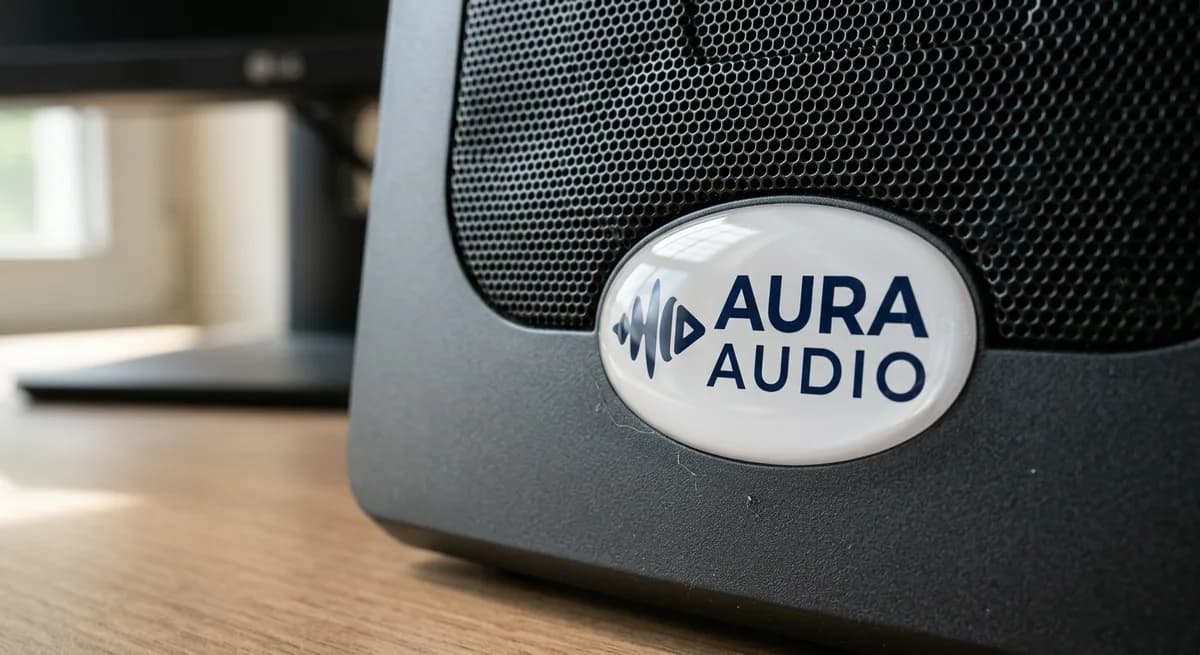
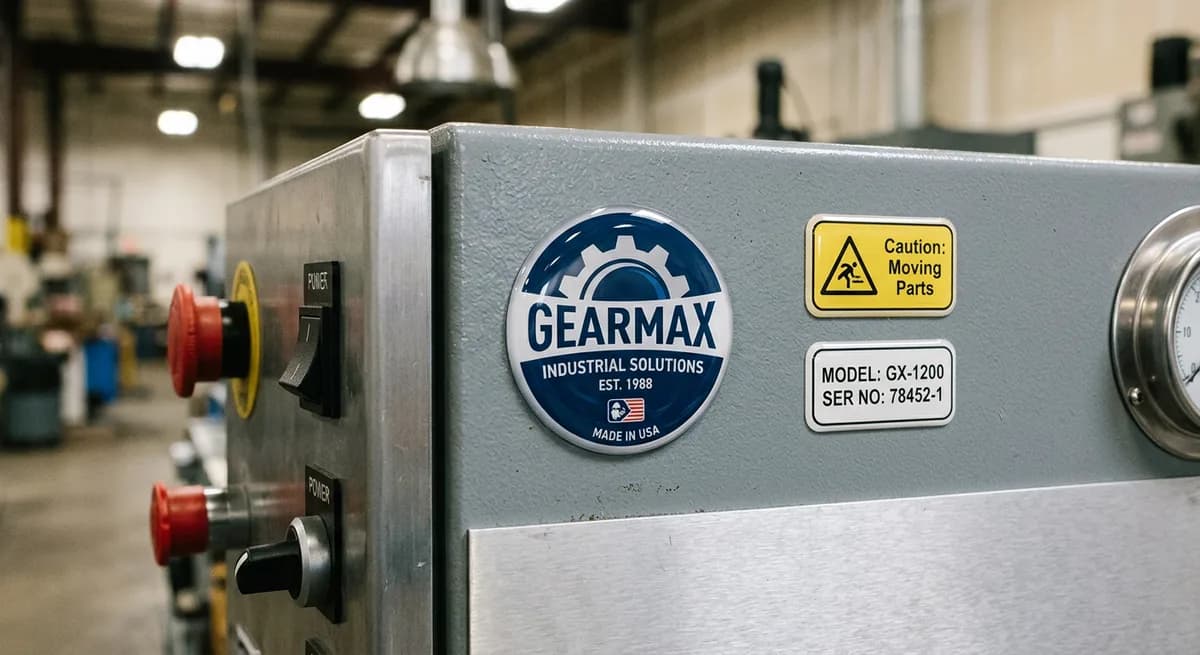
A 3D polyurethane dome label starts as a high-resolution graphic printed onto a metallic silver, brushed aluminum, chrome, white, or clear synthetic film substrate (typically 3M or Avery Dennison vinyl/polyester), kiss-cut to shape, and flooded with a metered two-part optical-grade liquid polyurethane resin. Surface tension holds the liquid resin right at the die-cut edge until it cures into a crystal-clear, 1.5 mm to 2.0 mm meniscus lens.
Why Engineers Specify Polyurethane Over Epoxy
- • Self-healing elastomeric memory: Automotive-grade two-part polyurethane has a Shore A hardness around 80–85. If struck by a tool or fingernail, the dome compresses and rebounds without cracking or leaving a white crease mark.
- • Zero yellowing under UV: Aliphatic polyurethane chemistry resists UV breakdown for 5–10+ years outdoors. Cheap promotional badges often use hard aromatic epoxy resin, which turns amber, chalks, and cracks within 6 to 12 months in sunlight (see our polyurethane vs. epoxy lab comparison).
- • Full-color gradients & zero mold fees: Because the underlying print is digital or screen-printed before doming, you can run multi-color gradients, drop shadows, or metallic-ink effects at 100 units or 100,000 units with zero steel-mold investment.
Design Constraints & Failure Modes to Watch
- • Minimum corner radius (≥ 1.5 mm): Liquid resin flows smoothly around rounded corners. Razor-sharp 90° exterior points or ultra-thin freestanding letters (< 2.5 mm stroke width) will starve of resin or overflow during pouring.
- • Continuous base silhouette: A dome label must have a continuous perimeter (circle, oval, rounded rectangle, shield, or contoured outline). If your design requires detached individual letters with zero background between them, jump to Method 02 (Electroformed Nickel).
- • Recessed cavity rule: Always design a 0.8 mm to 1.2 mm recessed pocket into injection-molded parts so operators cannot catch a fingernail under the perimeter edge of the badge.
Electroformed Nickel & Metal Transfer Stickers (0.08–0.15 mm)
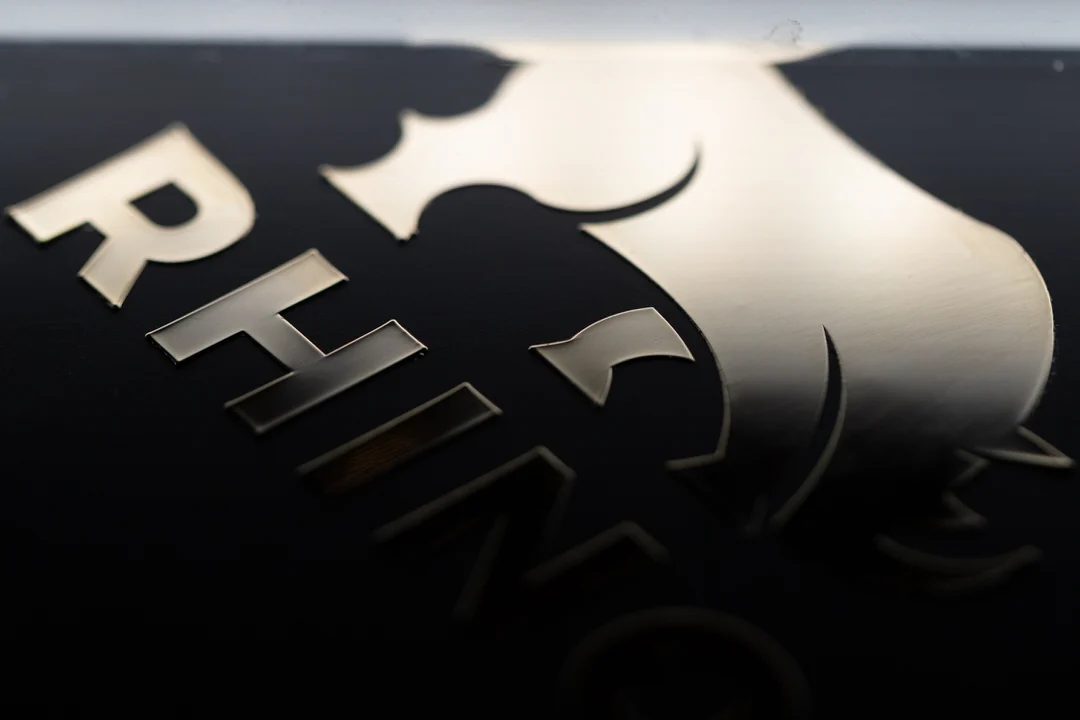
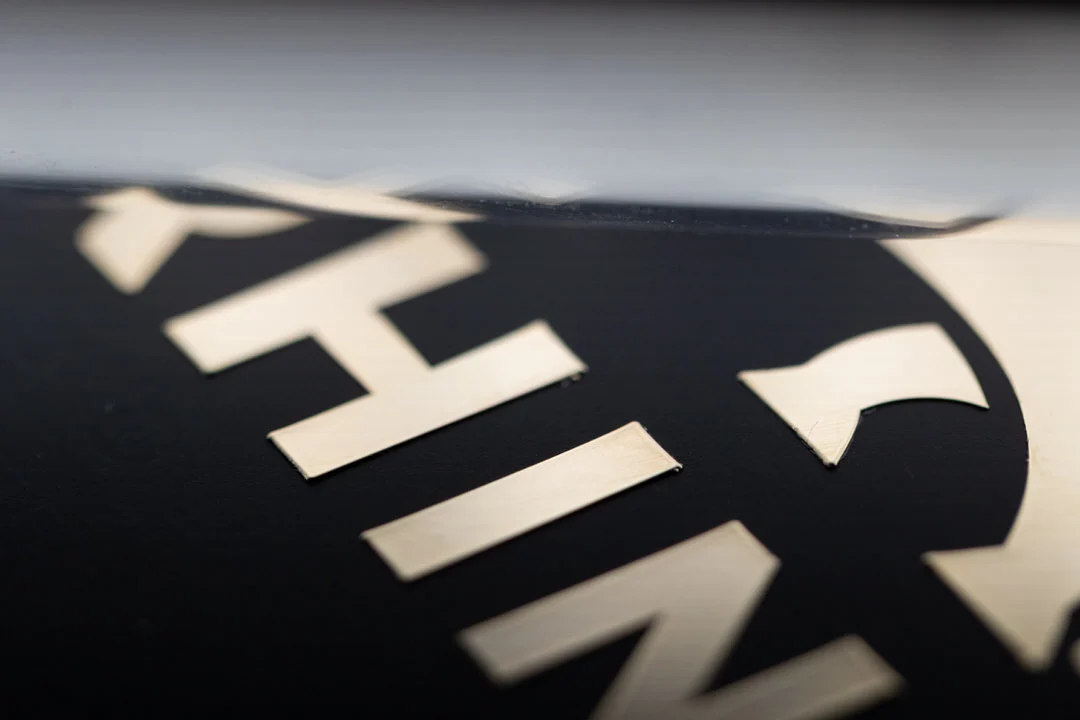
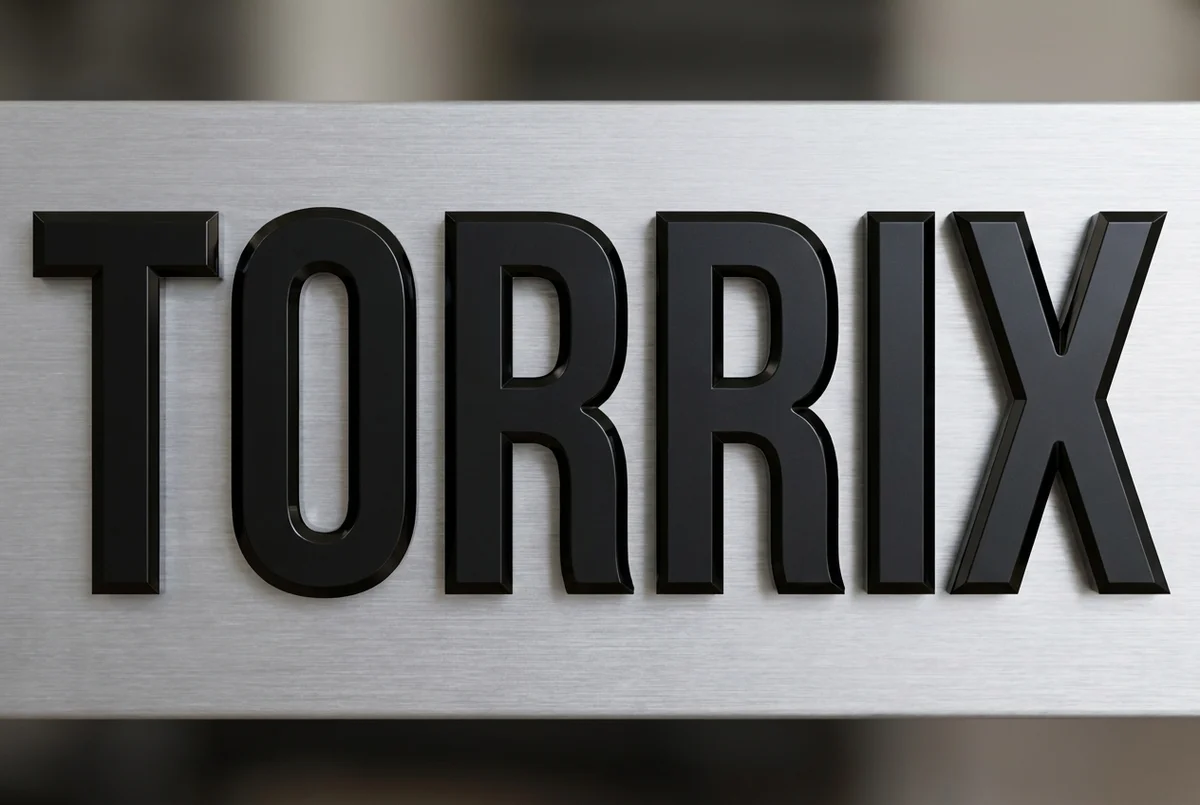
When you inspect the razor-sharp, paper-thin chrome or brushed gold brand lettering on a high-end espresso machine, studio microphone, laptop lid, or luxury perfume bottle—where every letter sits directly on the housing with no clear vinyl background uniting them—you are looking at an electroformed nickel transfer sticker (often called a metal transfer sticker or 3D nickel sticker).
Unlike stamped aluminum, electroformed badges are not punched with mechanical dies. Instead, a stainless steel mandrel plate is coated with photoresist and exposed through a UV photomask. When submerged in an electrified nickel sulfamate bath, pure nickel ions deposit onto the conductive areas atom-by-atom until the metal reaches 80 to 150 microns (0.08 mm – 0.15 mm). The grown metal characters can then be plated in mirror chrome, 24K gold, black nickel, gunmetal, or brushed satin, pre-coated with a precision-masked pressure-sensitive adhesive on the back, and held in exact registration by a clear top transfer carrier film.
Shop-Floor Reality: Where Electroformed Nickel Excels vs. Where It Fails
Strengths:
- • Unmatched fine detail: Because the metal is grown via photolithography rather than cut by a blade, stroke widths down to 0.25 mm, sharp 90° corners, and micro-textured diamond or CD-spin patterns come out crisp.
- • Ultra-low profile (0.10 mm): Almost flush with the surface—no recessed bezel required on sleek consumer electronics or glass panels.
- • Low photomask tooling cost: Usually $80 to $250, making 300-piece pilot runs completely viable.
Shop-Floor Pitfalls:
- • Requires smooth substrates: The adhesive layer under a 0.10 mm nickel letter is only 0.03–0.05 mm thick. If you apply tiny freestanding letters onto coarse crinkle powder coat or heavily pebbled plastic, the adhesive only touches the high peaks and letters can flick off during cleaning.
- • 180° peel angle during assembly: Line operators must burnish the top carrier film with a felt squeegee and peel the carrier back flat at a 180° angle—pulling straight up at 90° can lift delicate punctuation marks before the adhesive reaches ultimate bond strength.
Dimensional Embossed Chrome Badges & Injection-Molded ABS Emblems
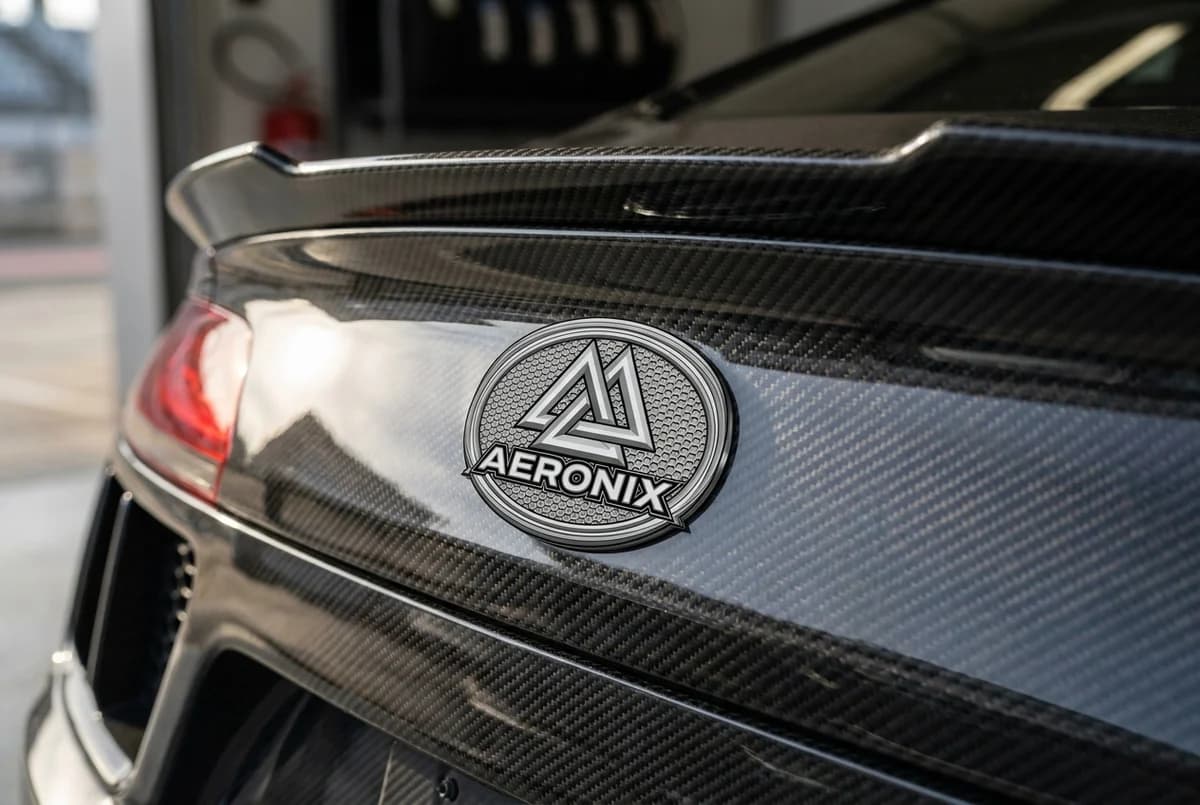
When a product needs the bold, sculpted, high-relief metallic presence of an automotive tailgate badge or a commercial appliance nameplate—with sharp beveled walls, raised chrome borders, and recessed textured or color-filled backgrounds—flat printing and liquid doming cannot create those mechanical facets. Depending on your part thickness, surface curvature, and tooling budget, engineers choose between two distinct dimensional technologies:
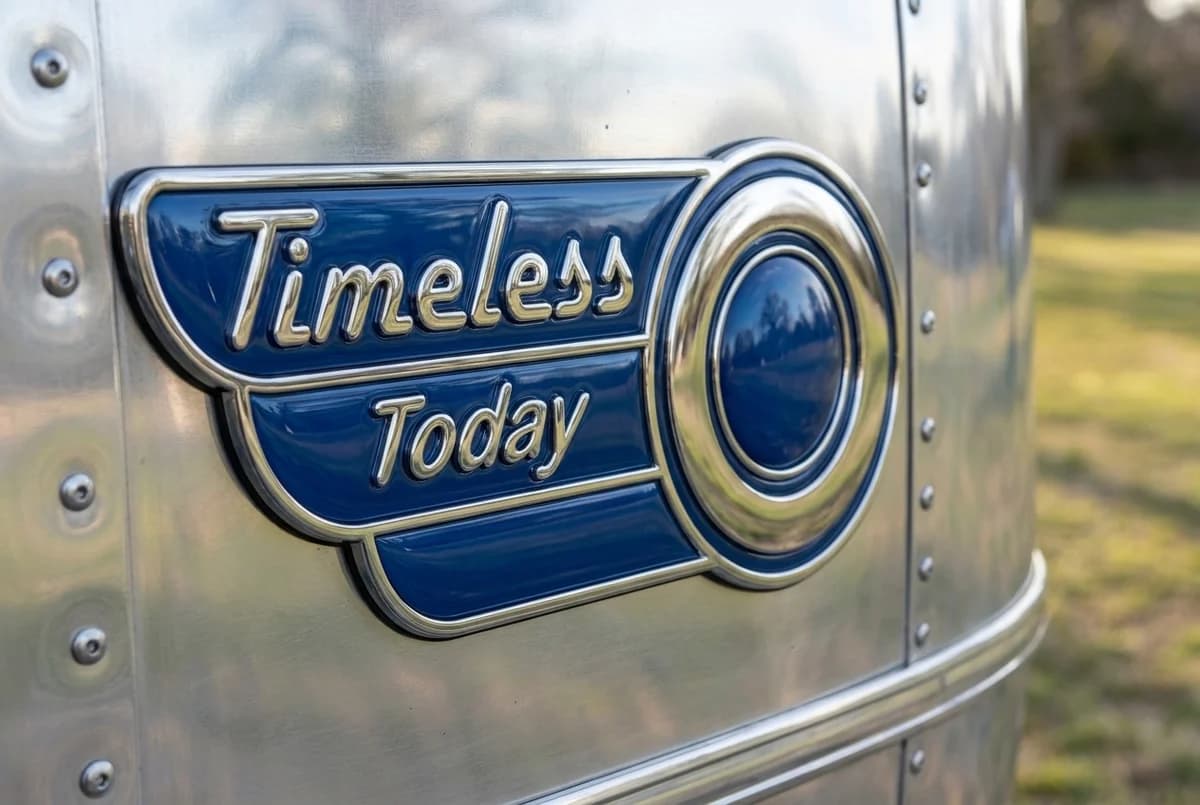
3A. Flexible Embossed Metallic Foil Badges (0.4 mm – 0.8 mm)
Manufactured by screen-printing UV-stable inks and protective clear coats onto a multi-layer metallized polymer/chrome laminate, then heat-forming the sheet in a matched male/female CNC brass or steel embossing die before die-cutting the perimeter with automotive-grade acrylic adhesive.
- • Conforms to curved housings: Unlike rigid injection-molded plastic, a 0.5 mm embossed metallic badge flexes smoothly around cylindrical tanks, curved appliance doors, helmets, and machinery shrouds without popping loose.
- • Fraction of injection mold cost: Matched embossing dies typically run $300 to $900 with 2–3 week turnaround, compared to $3,000–$6,000 and 6–8 weeks for hard steel injection tooling.
- • Selective texture & color: Easily combines mirror chrome raised lettering with matte black, brushed silver, or translucent candy-colored recessed zones in a single pass.
3B. Injection-Molded ABS Chrome Emblems (2.0 mm – 4.5 mm)
Produced by injecting electroplating-grade ABS (or PC/ABS blend) resin into a hardened steel cavity mold, etching the raw plastic in an acid bath, and running it through multi-stage copper, semi-bright nickel, bright nickel, and trivalent chromium plating tanks (or PVD vacuum metallizing / matte automotive paint).
- • Maximum physical depth: Achieves 3.0 mm to 4.5 mm vertical walls, sharp 45° chamfers, and optional rear alignment pins (locating bosses) that snap into pre-punched sheet metal holes.
- • Backed with 0.8 mm – 1.1 mm VHB / acrylic foam tape: Precision rotary-die-cut closed-cell acrylic foam tape absorbs thermal expansion differentials between the ABS badge and painted steel body panels from -40°C to +90°C.
- • High-volume unit economics: Once the $2,500–$6,000 steel mold is amortized across 5,000+ units, per-piece cost drops dramatically.
Sub-Surface Printed Polycarbonate (Lexan) & Polyester Graphic Overlays
Whenever your branding shares real estate with user controls—pushbuttons, rotary encoder scales, status LEDs, or a digital LCD/7-segment display—a standalone badge is the wrong tool. Industrial instruments, medical diagnostics, CNC pendants, and laboratory equipment rely on sub-surface printed polycarbonate (often specified by the SABIC brand name Lexan®) or polyester (PET) graphic overlays.
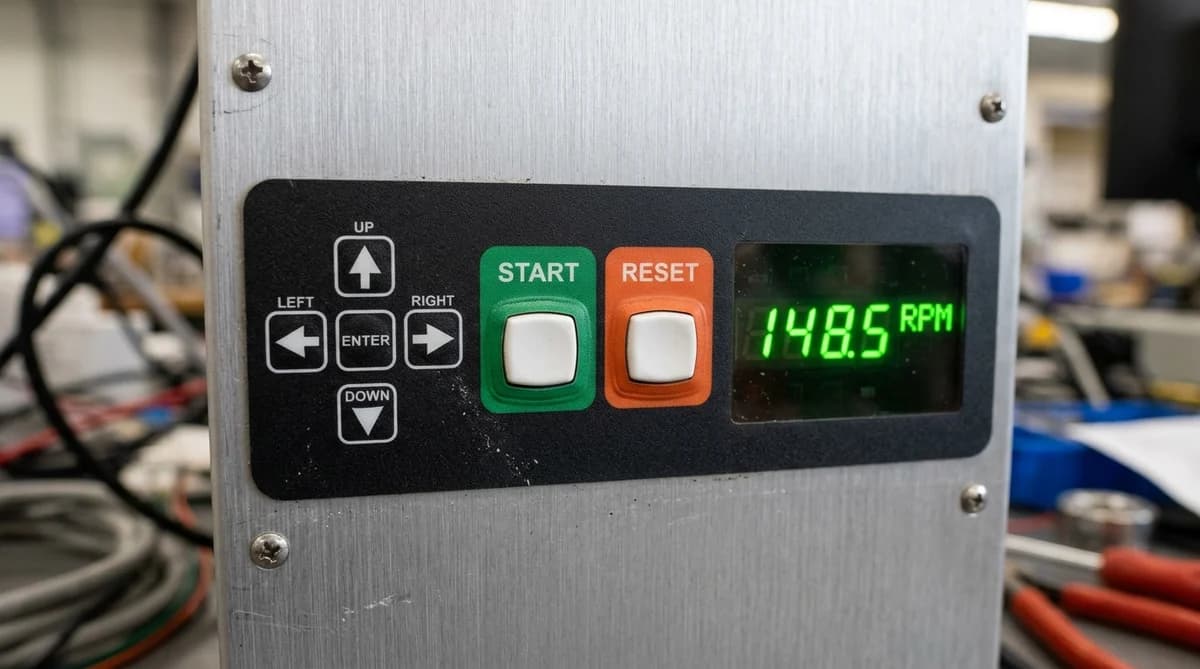
Why Sub-Surface Printing Never Wears Off
In a sub-surface (second-surface) overlay, the artwork is screen-printed or digitally printed in mirror-reverse onto the back side of a clear or velvet-textured 0.175 mm to 0.375 mm (7 mil to 15 mil) polycarbonate film, followed by an opaque flood coat and selective die-cut 3M adhesive.
Because the operator's gloved finger, screwdriver, or cleaning rag only ever touches the raw polycarbonate top surface, it is physically impossible to scratch or wipe off the printed ink.
Polycarbonate (PC) vs. Polyester (PET): Which to Spec?
- • Polycarbonate (Lexan): Easier to die-cut, laser-cut, and pillow-emboss with crisp edges; optically clearer for display windows. Best for indoor/general industrial panels up to ~100,000 button actuations.
- • Polyester (Autotex / Mylar PET): Specify PET if a membrane switch key will be pressed over 1,000,000 cycles (polycarbonate eventually micro-cracks along sharp emboss creases) or if the panel faces harsh ketones, brake fluid, or concentrated hospital disinfectants.
Anodized Aluminum & Laser-Etched Stainless Steel Serial Nameplates
Every piece of industrial machinery, 3-phase electric motor, hydraulic valve block, pressure vessel, or commercial HVAC compressor requires two distinct layers of identification: a front-facing brand badge, and a permanent regulatory rating plate (serial number tag) carrying voltage/amperage specs, UL/CSA/CE/ATEX markings, manufacture date, and a 2D DataMatrix or QR code for field service traceability.
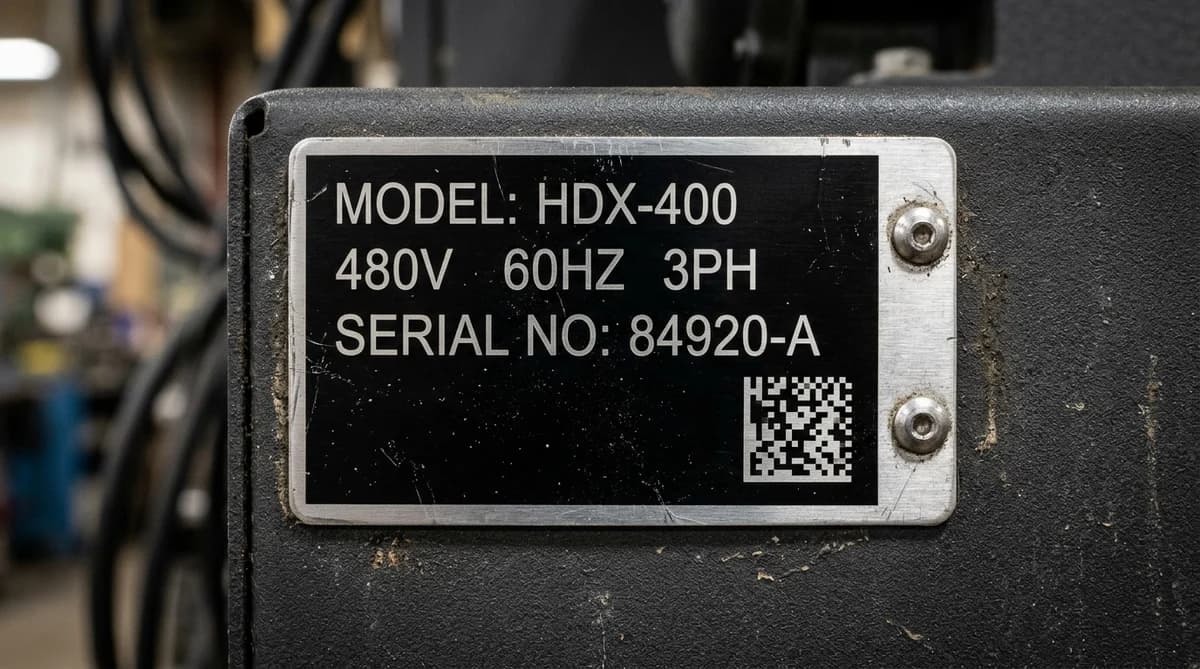
MODEL: HDX-400, 480V 60HZ 3PH, sequential serial number, and high-contrast 2D DataMatrix barcode) mounted on a crinkle-coated motor housing.Photo-Anodized Aluminum (Metalphoto®)
Silver halide graphics are developed inside the open pores of anodized aluminum and sealed under a sapphire-hard anodic oxide layer. Survives 20+ years outdoors, salt fog, hydraulic fluid, and temperatures up to 340°C (650°F). Meets MIL-STD-130 for UID barcodes.
Fiber-Laser Etched Black Anodized Aluminum
Cost-effective and fast for variable serial numbers: a sheet of 0.5 mm to 1.0 mm black-dyed anodized aluminum is ablated by a fiber laser or CO2 laser, exposing crisp white/silver aluminum oxide contrast underneath with zero ink required.
Chemical-Etched 304 / 316 Stainless Steel
Mandatory for offshore oil & gas, chemical processing, food washdown, and mining where caustic cleaners strip aluminum. Characters are acid-etched 0.15 mm deep into 316 stainless steel and optionally stove-enameled so the plate remains readable even if painted over.
UV DTF Crystal Transfers & 3D Soft PVC / Silicone Rubber Badges
Not every production batch justifies plating mandrels or embossing dies, and not every product has a rigid housing. Two specialized branding methods fill these gaps at opposite ends of the material spectrum:
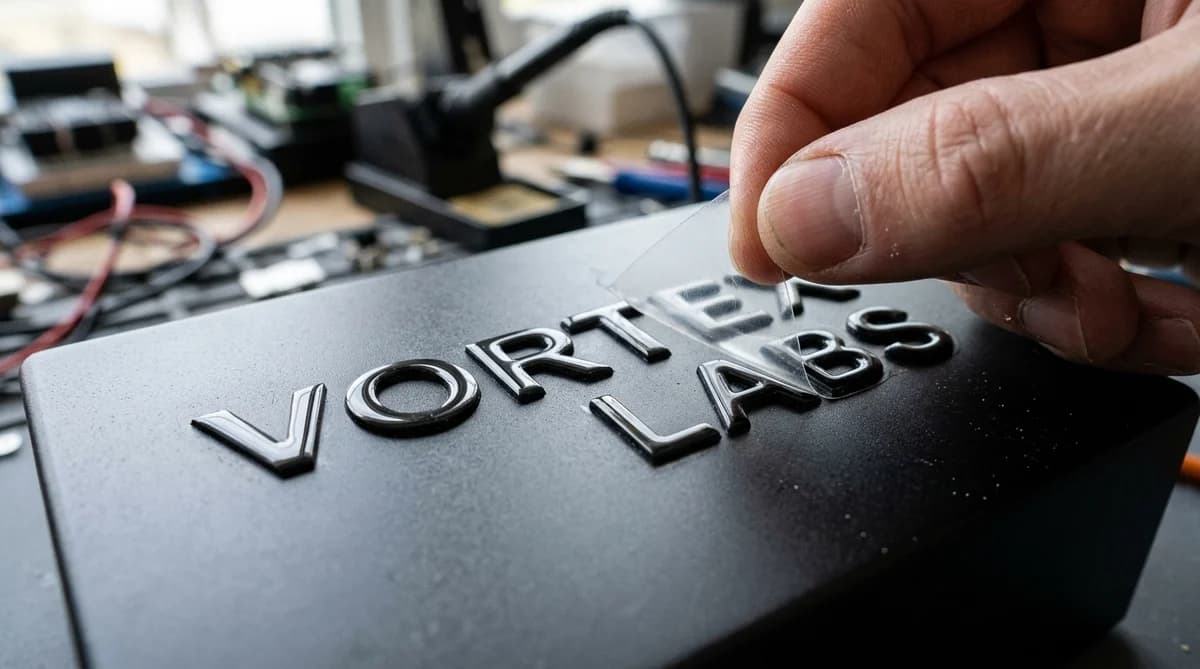
6A. UV DTF Crystal Transfers: Great for Prototypes, Risky Outdoors
UV DTF (Direct-to-Film) stickers have exploded in popularity because they mimic the freestanding, borderless look of a pad-printed or electroformed logo with $0 tooling and a 10-piece minimum.
The engineering caveat: Cured UV inkjet varnish is cross-linked acrylic oligomer—it is relatively brittle compared to two-part polyurethane or solid nickel. Under continuous outdoor sunlight, thermal expansion on metal housings, or repeated alcohol/solvent wiping, thin UV DTF characters can chip or delaminate. Use UV DTF for engineering prototypes, trade-show samples, and indoor hard goods; graduate to Electroformed Nickel (Method 02) or Polyurethane Dome Labels (Method 01) for long-life production.
6B. 3D Soft PVC & Liquid Silicone Rubber Badges
When your product is flexible or subject to heavy drop impacts—tactical cases, neoprene covers, heavy power-tool battery boots, marine canvas, or industrial wire harnesses—rigid metal or hard plastic badges fail.
Micro-injected 3D soft PVC or silicone badges are dispensed liquid-color-by-color into a CNC aluminum mold ($90–$180 tooling) with a sewing channel around the perimeter, Velcro backing, or heat-activated/3M adhesive. Colors are solid pigmented elastomer all the way through, so they can never scratch off.
Direct Silkscreen / Pad Printing & Tamper-Evident Security Seals
Walk around to the rear panel of almost any rackmount server, industrial PLC, audio interface, or power supply and you will see two final identification processes working side-by-side: direct 2-part epoxy silkscreen / pad printing for dense I/O connector callouts, and destructible or VOID tamper-evident security labels across the chassis seam screws.
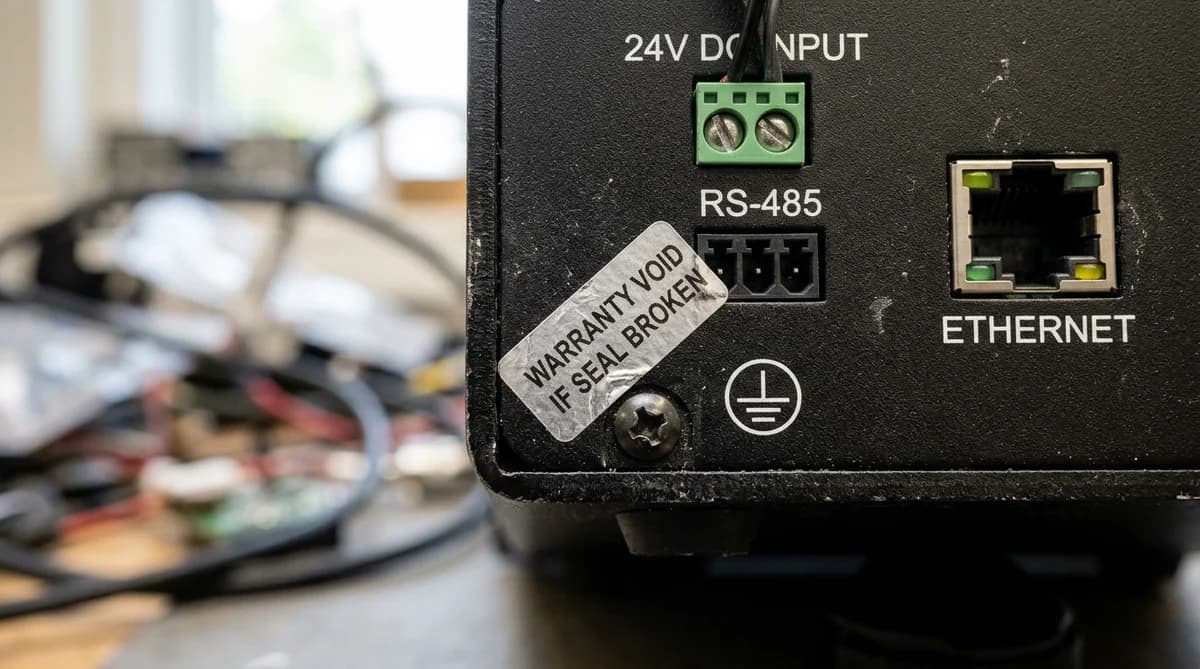
When to Print Directly vs. When to Apply a Separate Badge
Direct silkscreen (for flat sheet metal) and silicone pad printing (tampography, for curved molded plastics) are unbeatable for printing 30 tiny connector labels (24V DC IN, RS-485, ETHERNET, pinout diagrams) in a single hit once the fixture and screen are set up.
Why OEMs decouple the primary brand mark from direct printing: If a sheet-metal vendor misprints a silkscreened logo on 15% of your anodized enclosures, you have to scrap or strip the entire metal housing. And if you sell the same hardware under 3 OEM/private-label brands, pre-printed enclosures split your inventory into 3 separate SKUs. Keeping functional I/O legends silkscreened in neutral white while applying the brand logo via a recessed 3D dome badge, electroformed transfer, or embossed emblem at final pack-out lets you stock a single universal housing.
Tamper-Evident Security Labels (VOID Polyester vs. Destructible Vinyl)
- • 2-mil Tamper-Evident VOID Polyester: Leaves a permanent checkerboard or
VOID OPENpattern behind on the enclosure and inside the label face if peeled. Ideal for calibration seals and enclosure seams on anodized metal and high-energy plastics. - • Ultra-Destructible Cast Vinyl (Acetate): Engineered with lower internal cohesive strength than the adhesive bond. If a technician tries to lift a corner with a razor blade, the film shatters into tiny paint-like flakes. Impossible to remove in one piece or re-apply.
The #1 Cause of Field Failures: Matching Adhesive Chemistry to Surface Energy
Whether you choose a polyurethane dome badge, an electroformed nickel transfer, an embossed metallic emblem, or a polycarbonate graphic overlay, the badge is only as reliable as the pressure-sensitive adhesive (PSA) laminated to its underside. In manufacturing engineering, substrates are classified by surface energy (measured in dynes/cm):
Stainless Steel, Aluminum, Glass, ABS, Polycarbonate
Adhesive wets out easily. Standard industrial acrylic transfer adhesives (such as 3M 467MP / 468MP for smooth surfaces) achieve full shear and peel strength within 48–72 hours after firm roller pressure at 20°C+.
Polypropylene (PP), Polyethylene (HDPE), TPO, Nylon
Standard acrylic adhesives bead up microscopically and peel right off within days. You must specify an LSE-formulated modified acrylic adhesive (such as 3M 300LSE / 9472LE) or flame/corona pre-treat the plastic before labeling.
Crinkle Powder Coat, Cast Iron, Pebbled ABS
Thin 0.05 mm transfer tapes bridge across the peaks and trap air in the valleys. Specify a thicker 0.13 mm (5 mil) heavy adhesive coat or a 0.4 mm – 0.8 mm conformable acrylic foam carrier that flows into the surface texture.
Need a printable shop-floor SOP for your assembly operators? Download our free Industrial Label Surface Prep & Application Checklist (CSV + Guide).
Frequently Asked Questions from OEM & Product Design Teams
What is the difference between electroformed nickel stickers and embossed chrome or ABS emblems?
Electroformed nickel stickers are grown atom-by-atom in a nickel sulfamate plating bath to a thickness of 0.08 mm to 0.15 mm. They apply via a clear top carrier film so individual script letters and detached logo islands bond directly to the enclosure with no background border. Embossed metallic foil badges (0.4 mm to 0.8 mm) and injection-molded ABS chrome emblems (2.0 mm to 4.5 mm) are thicker, single-piece dimensional badges backed with automotive acrylic foam tape for larger exterior panels, vehicles, and appliances.
When should an OEM use a polycarbonate (Lexan) graphic overlay instead of a 3D badge?
Use a sub-surface printed polycarbonate or polyester graphic overlay whenever the label has to cover membrane switch buttons, indicator LEDs, digital display windows, or an entire control panel face. Because the ink is printed on the underside of a 0.175 mm to 0.375 mm velvet-textured film, operator fingers never touch the ink layer. Use a 3D polyurethane dome badge, electroformed transfer, or molded ABS emblem solely for the primary brand mark.
Why do adhesive badges peel off powder-coated steel or molded polypropylene housings?
Standard general-purpose acrylic adhesives are formulated for smooth, high-surface-energy metals and glass (above 45 dynes/cm). Low-surface-energy plastics like polypropylene (29 dynes/cm) and polyethylene (31 dynes/cm), or coarse crinkle powder coats, prevent standard adhesives from wetting out. Specify a high-tack LSE modified acrylic adhesive (such as 3M 9472LE / 300LSE) for plastics, or a 0.4 mm to 1.1 mm conformable acrylic foam tape for textured powder-coated sheet metal.
What is the best branding method for permanent UL/CE ratings and sequential serial numbers?
For heavy machinery, electric motors, valves, and outdoor utility hardware that require permanent regulatory data, anodized aluminum (Metalphoto) or fiber-laser etched 316 stainless steel nameplates fastened with pop-rivets or high-temperature adhesive are the industry standard. Unlike printed vinyl, etched stainless and sealed photo-anodized aluminum remain legible after salt spray, solvent washdowns, and abrasion.
Are UV DTF transfer stickers durable enough for permanent industrial equipment branding?
UV DTF crystal transfers work well for short-run packaging, indoor promotional electronics, and prototypes because they require zero tooling. However, cured UV varnish layers become brittle under continuous outdoor UV exposure, thermal cycling, and chemical wipe-downs. For multi-year field durability without a background carrier film, electroformed nickel transfer labels are far more reliable.
Specifying 3D Polyurethane Dome Badges for Your Next Production Run?
If your enclosure design calls for Method 01 (Automotive-Grade 3D Polyurethane Dome Labels)—whether seated inside a molded bezel on consumer electronics or bonded with LSE adhesive onto powder-coated industrial machinery—you can configure exact dimensions, check volume pricing, or request a material sample kit directly from our production team.